Benefits of Wooden Storm Windows for Energy Efficiency
Editorial & Photography By: Dr. Christopher Cooper

Yes, it’s that time of the year. There is a little nip in the air that reminds you to get those storm windows installed. Why not just replace the most character defining element on your home, with plastic windows you ask! Do you know why they are called replacement windows? It’s because you will have to replace them over and over again! Let’s go over a bit of “What-To”, even a bit of science.
For decades now window manufacturers have sponsored studies to prove that traditional wooden window systems aren’t energy efficient. Of course today the window manufacturers are hard at work replacing windows. They are not replacing antique wooden windows. Instead, they are replacing the plastic windows they installed as little as a decade earlier.
Very simply, a traditional wooden window coupled with a traditional wooden storm is equal to a thermal replacement window. In some cases, it can be more energy efficient. The traditional window system in an older home is the most important character defining element of all.
Just do the math!

Note how distracting raw aluminum storms can be.
If there is as much as 20 percent† of the heat loss through single glazed windows. That percentage can be reduced in half. This can be achieved by simple restoration techniques applied to the principal sash. And, by installing another layer of glazing in the guise of a wooden storm window. These can be built by the average home woodworker for less than $200. This estimate is based on a storm window 3′-0” x 5′-0” providing a U-value of 0.50‡). The frugal homeowner should realize that the $200 spent building a storm window can very easily be recovered. This recovery happens through energy savings. This can happen in approximately five years.
On the other hand if the ill-advised replace their original system with a new thermal unit. A plastic thermal replacement window costs approximately $1,300 (installed) or more. The return on the investment would not be realized for approximately 250 years! I would hate to see what a plastic window would look like after 25 years. They are already ugly when they are new!

The same aluminum storm painted out to match the existing colour scheme of the principal sash windows.
A huge trend in the 1970s was to install aluminum storm windows over older wooden sash windows. I do and I don’t have a problem with this. Raw aluminum is unattractive. Some measure should be taken to paint the aluminum storm to better blend with the sash. Many problems arise with these types of storms. They can hold copious amounts of water on the interior side. Many people caulk the bottom where it comes in contact with the sill or sub sill. This area where the storm comes in contact with the sill or sub sill should not be caulked or sealed. Moisture needs to find its way under and out of the interior. This is true even on a wooden storm window.
The newer plastic storm windows, in my opinion, are completely useless. They will become brittle in as little as five years. Wooden storm windows, on the other hand, have been in service in many cases as long as 140 plus years. Our Blenheim Farm location still has original storm windows in place on the summer kitchen which was built in 1877. Yes these storms have many condition problems, nonetheless, what would a plastic window look like after 147 years?

I have been asked the question, what are the holes for in the bottom of the storm window? These are clever little vents with a wooden flap to close them off. Whenever you have a steamed-up window in the winter, swing these flaps open on the interior side. If you just want some fresh air on a warm winters day, swing these flaps open. You will be amazed at how much fresh air you can get out of three or four little holes (see Image 1).


Above Image 4: Segmented windows can be properly hung on a single hanger. Note the long eye hooks used to set the storm in an awning position. This is a very simple and cost effective approach. Full circle head and Gothic head windows can be hinged at their sides. They can be operated with casement window hardware.

One of the biggest drawbacks with respects to heavy wooden storm windows is that they need to be removed every summer. They also need to be stored away. During the hot and humid summer months, damaging condensation can attack the principal window and cause rot issues. As technology advanced in wooden storm windows, so did the hardware. I have always recommended that storms are set on hangers (see Image 2 above). They should also have a set of articulating window adjusters (see Image 3 above). These window adjusters set the window in an awning position (see Image 4 above). Best of all, they lock the storm in place adding a secondary level of security for your home. There are no heavy storms to stow away in the summer.

As for weather stripping I recommend EPDM weather stripping (available at most hardware and big box stores, see above). Place the weather stripping on three sides of the storm window. Apply it to the left, the right and the top of the storm. Ensure it sits flush either on the exterior trim (see Image 5) or in the rebate. The rebate may be in later windows of the nineteenth century and early twentieth century (see Image 6). Never seal the lower portion! Once the window adjusters are locked into place the EPDM will compress and keep a positive draught-proof seal.

There are a variety of storm windows available. They have lower glass panels that can be changed out in the summertime for screens. These are usually fussy and, in my opinion, overpriced options. You can better serve these windows with window adjusters. Additionally, an accordion screen can fit snugly under the lower sash of the principal window. Never use interior storm windows. Here is a direct quote from the National Parks Service Preservation Briefs. “Moisture can become trapped between the layers of glazing. It can condense on the colder, outer prime window. This potentially leads to deterioration.” The correct approach to using interior storms is to create a seal on the interior storm. At the same time, allow some ventilation around the prime window. In actual practice, the creation of such a durable, airtight seal is impossible.” Never use shrink plastic. This causes the same problem. It will discolour and tear the paint on the interior trim work.
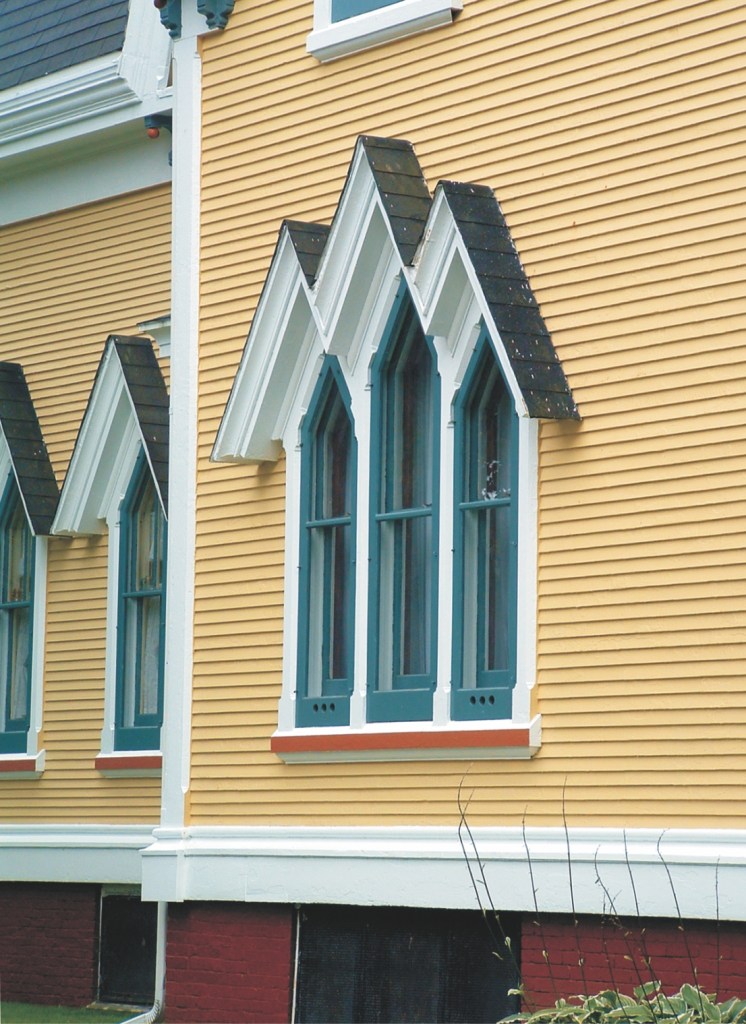
An example of quality craftsmanship, note the intricacy of these Gothic-head storms

Wooden storms always create the right look for a heritage property, even when they are showing their age.
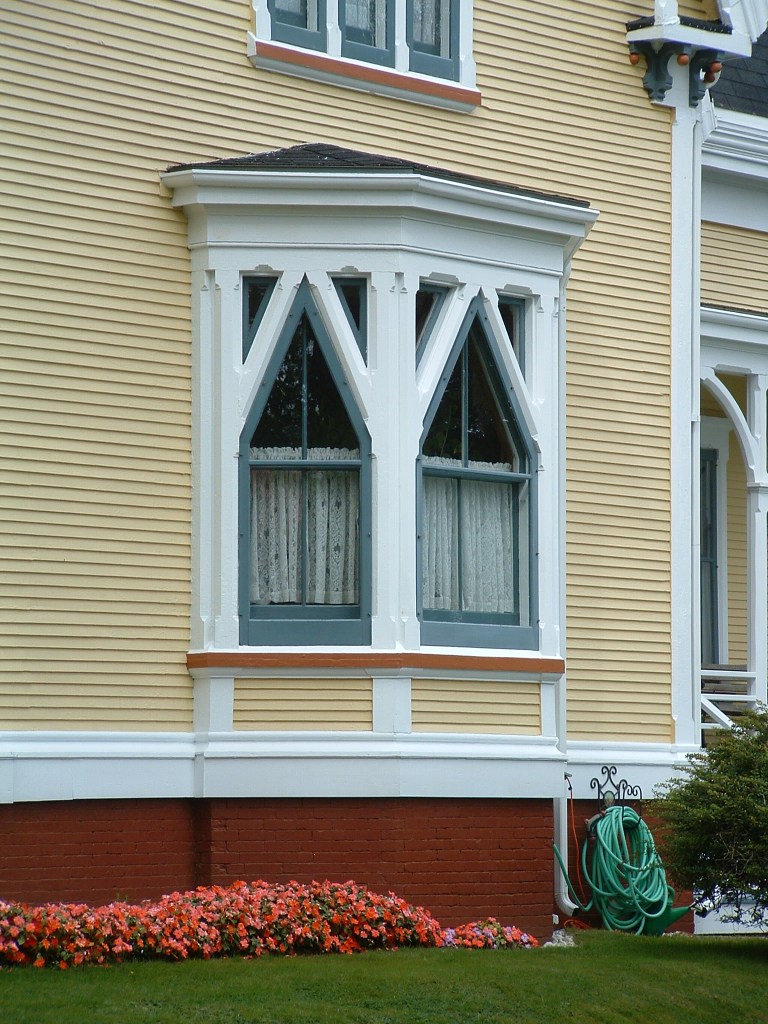
The old wooden windows in your home have given you and your predecessors great service. Good stewardship and good energy savings can be had in restoration and by providing a good quality wooden storm! Take care of your wood windows and storms and they will give you an indefinite number of years of service!
SIDE BAR:
† The principal culprit affecting energy consumption is air infiltration. It can account for as much as 50 percent of the total heat loss of a building. Sadly, a couple of hundred dollars in caulking can reverse this number. This can be done without removing windows and destroying character-defining plaster walls. It avoids creating a health issue with other chemicals and foams being pumped into walls that can no longer breathe!
‡ The U-value (or U-factor) is more correctly called the overall heat transfer coefficient. It measures the rate of heat transfer through a building element. This measurement is over a given area, under standardized conditions. The smaller the U-value the better it is, which is the inverse of an R-Factor.
Find Your Calling in the Heritage Trades!