Welcome to Season Two of Old Home Living Television. Episode One is below, if you are having issue with the episode not playing visit our website HERE
See full film transcript below:
Pond Bridge is on the market, looking for a new Steward
Find out more details by clicking the link below
Subscribe today to get new articles and episodes of Old Home Living Streaming Television absolutely FREE directly to your email box

Note: We never sell or rent our subscribers information EVER!
Find your calling with professional education in the restoration arts at the Edifice Atelier

Film Transcript:
Hello folks, It’s Christopher Cooper… your old home doctor…
TRUTH is the fundamental principle of architecture. Of the many architectural styles which have, at one time or another, achieved popularity, those memorable few which most creditably bear the test of time are precisely the ones which reflect, faithfully and without distortion, the economic and social conditions out of which they sprang. My love for the Georgian form brings us today to the vibrant heritage tapestry that is Pond Bridge, an untouched Georgian beauty located just east of Liverpool Nova Scotia.
With the arrival of autumn, the old, gated drive ensconced in centuries old trees have been transformed into a vivid tapestry. The foliage began to turn lemon yellow, crimson red, russet, gold, and bronze. The woods, awash with brilliant hues, seemed almost aflame with colour. The melodious rush of water encircled this enchanting island, serenading the landscape with its gentle song.
That same wind, fresh and cool, swept away the fever of everyday life that had clouded my mind. The old house and barn, stretched out before me, filled with promise and the allure of new architectural adventures. The old house seemed to beckon with endless possibility, and my heart swelled with the sheer wonder of it all, nearly bursting with excitement and anticipation to explore this amazing site.
The old, shingled barn was a common late 19th century agrarian edifice that held a very special interior. I threw open the old wooden doors and stepped in, my eyes adjusting to what seemed like a mirage tricking my eyes, it was certainly not common by any means. A wonderful space appeared, cathedral like, with soaring vaulted ceilings clad in wood. A river-stone fireplace, a monument to timeless comfort, promised a lifetime of shared stories and quiet moments by the hearth, or the ability to throw a sizable gala or even a teaching space. Stepping back outside and to the north was the bulk of this island paradise with old-growth trees and an original historic landscape intact.
Sadly, most 18th century properties have had their original Georgian landscapes slowly eroded by modernity, shrinking their original size and glory. Instead, these pieces of architectural folk art are now pressed up against modern, beige subdivision houses.
Pond Bridge is unique, as it sits on a 38-acre island surrounded by the Medway River and a sizeable mill tributary to the east. During the 18th century, the original builder of Pond Bridge established sawmills on the southern tip of this island, which became a center of technology and growth for the hamlet of Mill Village. While these timber and stone industrial buildings are now just foundations and ruins, they represent a significant part of the area’s history. This was also the location of Nova Scotia’s first steam-powered gang sawmill, introduced in the mid-nineteenth century. In its prime, Mill Village would have been a vibrant and bustling hub for industry and trade.
As an expert on standing remains, I have identified and documented significant historical remnants north of the house and barn. These include a stone bridge and leat associated with the property’s earliest mills. The bridge structure is unmistakably eighteenth-century, featuring a cast-iron axle for flood gates embedded in its revetment, despite having collapsed in the middle. Restoration of this bridge could certainly continue the property’s rich and romantic history. The area also retains its original mill pond, which presents an excellent opportunity for redevelopment into a fish or duck pond.
This rugged place is not just potential—it’s a sanctuary. I can already picture it, a timeless landscape where we can walk hand-in-paw with a faithful friend. Or perhaps, it holds a deeper secret: a scattering of secluded cabins, whispering their promise of quiet retreat among the old-growth trees and rocks.
The house itself is a testament to thoughtful restoration, respecting the original structure and celebrating the very timber bones she is built from. The current owner has taken stewardship of our built heritage to new heights! Casting aspersion to those who may have wanted to modernize the house with little thought or respect to the health and welfare of the original hand-hewn timber frame.
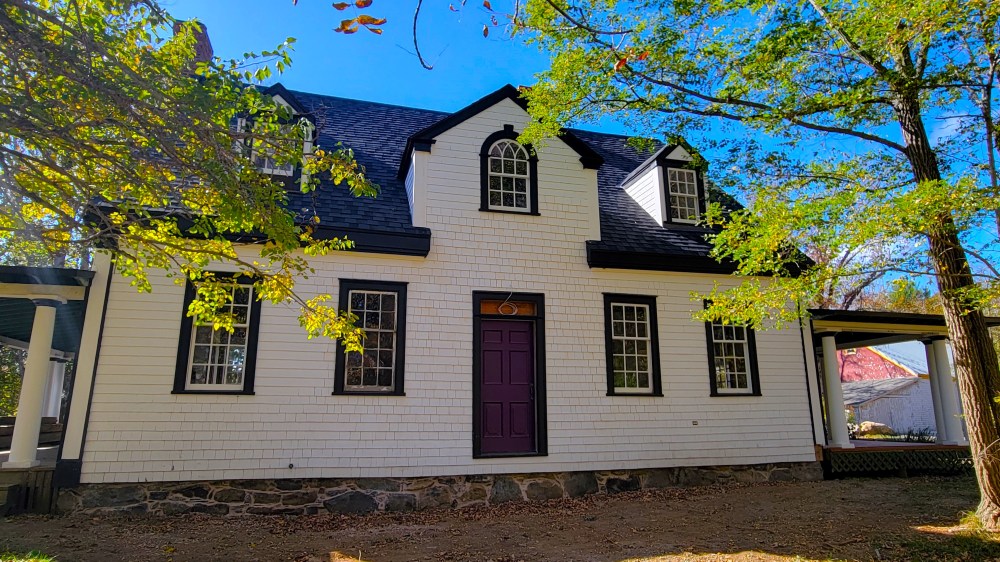
The house, built around the last quarter of the 18th century, has spent its life as a summer retreat. It is not a rough shack in the hinterlands of Nova Scotia; it is a refined Georgian beauty that has undergone very few additions over the centuries. Namely, a bay window that appears in an 1870s photograph was subsequently removed in the early 1930s for a splendid pair of Arts & Crafts, classically inspired verandahs bookending the original Georgian edifice, and the addition of a summer kitchen ell (c1870). The same 1870s photograph also shows a new Gothic frontispiece respecting the original shoulder dormers and the original 6-over-9-lite windows. Regarding the windows, all the windows from 1790 through the 1870s have been lovingly restored to live on for another 200+ years. Windows are the eyes and the soul of the house and the most important character-defining element of all in my opinion.
Restoration and preservation won the day over modernization and renovation. The entire original structure is as it was in the 18th and 19th centuries—untouched! Yes, of course it had some rot issues, but rather than covering them up, original old-growth timber was used to repair beams, rafters, etc., (Dutchman techniques) by qualified Edifice Guild craftspeople. The foundations have been repointed with the proper, traditional-lime-based mortar. Water management has been well-planned to keep the house snug and dry, all the while allowing the house to be permeable and, most importantly, allowing it to breathe!
The most amazing feature is the house’s frame; beams, joists, rafters, and their oak pegs are all on display, with soaring vaults on the second floor. The original fireplace, with what was once a beehive bake oven (long since removed, with only the door now surviving), gave the opportunity for an elevator to be sneaked in through the original framing without having to add new support framing—serendipity, me thinks!
The quiet strength of this house is revealed in its very bones. The modern heavy lifting has been completed, yet it remains gracefully hidden beneath its original eighteenth-century skin. A state-of-the-art central heating and air conditioning system and an underground electrical system (ready for a generator) are thoughtfully tucked away in a lovely “electrical cottage” with ample room for landscape equipment.
Consciously or unconsciously, we find profound satisfaction in that which is substantially and enduringly built. It is this innate sense and sheer architectural value that makes us admire the Pyramids, the temples of Greece, and the mighty cathedrals of the 13th century. That same instinct communicates, even to the most casual observer, the rugged strength of our old houses. Those who know these ancient dwellings more intimately, perhaps through the good fortune of exploring one, will truly know their delights.
The house now stands as a blank canvas—honest, straightforward, and gracefully devoid of pretension and sham. It is ready to live on for another 235 years and, one hopes, will find the same loving stewardship afforded a house and landscape of such Provincial and, dare I say, National importance! This house is, without question, the most well-preserved domestic Georgian I have ever had the pleasure of visiting and exploring.
Until next time folks… I’m Doctor Christopher Cooper… find your little piece of architectural folk art and learn how to repair, restore and preserve them… right here at Old Home Living and the Edifice Atelier… cheers!

